20 Interview Questions for New Zealand Student Visa With Suggestions and Answers
Updated On
-
Copy link
Discover the 20 most commonly asked interview questions for New Zealand Student Visa to help you prepare effectively. These questions help the interviewing officer assess your study plans, financial stability, and genuine intent to study in New Zealand.

Your Complete Canada PR Roadmap- From Eligibility to Visa

Table of Contents
Preparing for your visa interview is a critical step toward studying in New Zealand, and understanding the interview questions for New Zealand Student Visa can make a real difference. In 2025, the country approved around 4,276 out of 7,235 student visa applications from Indian applicants, reflecting an approval rate of approximately 59% (Source: Immigration New Zealand).
Having assisted 50+ interview candidates, I have observed that officers mainly focus on genuine intent, financial readiness, knowledge of your chosen course and institution, and post-study plans. So, to help you feel confident and prepared, I have listed the most commonly asked questions and their answers, followed by a preparation checklist and tips to tackle them effectively.
Interview Questions for New Zealand Student Visa and Their Answers
The student visa interview is a critical stage where immigration officers assess whether you are a genuine student under New Zealand’s immigration framework. According to the source, in 2025, 5,317 applications by Indian students were declined, which is about 10.9%, even though this marks a notable improvement compared to 2024. Therefore, understanding what immigration officers ask helps you provide clear and honest answers.
Here are some common interview questions for New Zealand Student Visa, along with their answers to guide you through the process.
|
Question |
Key Tip |
Sample Answer |
Common Pitfalls |
|---|---|---|---|
|
1 Where did you complete your studies in India? |
You should clearly mention the name of your institution and city to demonstrate your academic background and readiness for future studies. |
“I completed my undergraduate program at [Name of College/Institute] in [City].” |
Providing incomplete details or forgetting the institution name can create a poor impression. |
|
2 Have you visited New Zealand before? |
You should answer honestly and briefly explain the purpose and duration if you have visited. |
“No, I have not visited New Zealand before.” |
Giving inconsistent or unclear travel history may raise doubts. |
|
3 Why did you choose New Zealand for your studies? |
You should highlight specific reasons and aspirations related to your field, and mention how the education system in New Zealand would benefit your aspirations. |
“I chose New Zealand because of its excellent education system, multicultural environment, and the [specific] advantages offered by [Name of Institution], such as [specific programs, faculty, research opportunities, etc.] that align perfectly with my academic and career goals.” |
Giving generic answers without specific reasons can weaken your response. |
|
4 Do you have any relatives or friends in New Zealand? |
You should answer honestly and provide details if applicable. |
“I do not have any relatives or friends in New Zealand.” |
Hiding information or giving vague responses may reduce credibility. |
|
5 Why did you choose this college/university? |
You should demonstrate research about the institution and explain how it supports your career goals. |
“I chose [Name of College/University] because of its strong reputation in [your field of study] and the unique opportunities it offers, such as [specific facilities, programs, faculty, or research opportunities].” |
Not knowing details about the university may indicate poor preparation. |
|
6 Did you apply to any other colleges/universities? |
You should justify your choice and explain why your selected university is your top preference. |
“No, I have only applied to [University] because it offers the best program suited to my goals.” |
Failing to justify your preference may make your decision seem random. |
|
7 Can you tell me more about the course you have applied for? |
You should confidently explain course details such as duration, subjects, and outcomes.
(Quick Read: New Zealand Study Visa Requirements for Indian Students) |
“I have applied for a Bachelor's/Master's degree in [Field of Study]. The course starts on [Commencement Date] and ends on [End Date]. The curriculum includes [brief description of key subjects or focus areas].” |
Not knowing course structure or details reflects lack of preparation. |
|
8 How do you plan to cover your expenses? |
You should clearly explain your financial plan, whether it’s from family or a loan, and ensure it matches your submitted documents. |
“My parents will cover my expenses, and we have submitted all required financial documents.” |
Giving unclear or unsupported financial information may lead to rejection. |
|
9 Are you planning to work part-time in New Zealand? |
You should align your answer with visa rules and emphasize that studies are your priority. |
“If permitted, I may work part-time, to gain experience in my field. However, my primary focus is on my studies.” |
Overemphasizing work may suggest a lack of academic focus. |
|
10 What are your plans after completing your studies in New Zealand? |
You should present a clear and realistic career plan linked to your course. |
“After completing my studies, I plan to explore job opportunities in my field, either in New Zealand or internationally. My long-term goal is to apply the knowledge and skills I gain to contribute to [specific industry or community].” |
Giving vague or immigration-focused answers may raise concerns. |
|
11 Do you plan to return to your home country after graduation? |
You should highlight strong ties such as family, career, or opportunities in your home country. |
“Yes, I have my commitments to my family. So I plan to return and utilize my education to contribute to the development of my community.” |
Weak justification for returning may indicate immigrant intent. |
|
12 Can you demonstrate your English language proficiency? |
You should mention your test scores and show confidence in your communication skills. |
“Yes, I scored [Score] in [IELTS/PTE], demonstrating my proficiency.” |
Not remembering your score or test details may reduce credibility. |
|
13 How is your previous education relevant to your chosen course? |
You should clearly connect your past studies with your current course choice. |
“My previous education in [Field of Study] has provided a strong foundation in [specific subjects]. This course will allow me to deepen my expertise and pursue specialized areas of interest.” |
Lack of connection between past and current studies may raise doubts. |
|
14 Have you submitted all required documents? |
You should confidently confirm submission and be ready to present them if asked. |
“Yes, I have submitted all necessary documents, including my offer letter, financial documents, health insurance, and proof of English proficiency.” |
Missing or being unsure about documents may harm your application. |
|
15 Have you travelled to any other countries recently? |
You should explain your travel history clearly and relate it to your global exposure. |
“Yes, I have travelled to [List of Countries], which enhanced my understanding of different cultures.” |
Providing inconsistent travel details may raise suspicion. |
|
16 If your visa is approved, where will you be staying? |
You should provide clear accommodation details as per your application. |
“I will be staying at [Address or Accommodation details as per your visa application].” |
Not having accommodation planned may indicate poor preparation. |
|
17 What do your parents do? |
You should clearly state their occupations and income to demonstrate financial stability. |
“My father is a [Occupation] and my mother is a [Occupation], with a combined income of [Income].” |
Not knowing exact details may weaken your credibility. |
|
18 What is your educational background? |
You should present your academic journey clearly, including achievements and focus areas. |
“I have a [Degree] in [Field of Study] from [Institution]. My academic performance has been strong, with a focus on [specific subjects or achievements]. I aim to further my knowledge and skills through this program in New Zealand.” |
Giving vague or incomplete academic information may create doubts. |
|
19 How will this course help your future career goals? |
You should explain how the course will provide relevant skills and opportunities. |
“This course will equip me with specialized knowledge and skills necessary for my desired field, allowing me to pursue rewarding opportunities and make a positive impact.” |
Not linking the course to career goals reduces clarity. |
|
20 What do you know about New Zealand’s culture and lifestyle? |
You should show awareness of the country’s culture, values, and lifestyle. |
“New Zealand has a rich, diverse culture and a welcoming community. I am particularly drawn to its outdoor recreational opportunities and the emphasis on environmental sustainability.” |
Lack of knowledge about the country may indicate poor research. |
Tips to Answer Interview Questions for a New Zealand Student Visa
Preparing well for the interview questions for New Zealand Student Visa can significantly improve your chances of approval. From my experience handling student cases, I have noted that it is important to answer confidently, honestly, and clearly to demonstrate your genuine intent to study. Moreover, officers test consistency by asking the same question in different ways.
- Be Clear About Your Study Plans: Clearly explain why you chose your specific course and institution in New Zealand. Show that you have researched the program and how it aligns with your career goals to convince the officer of your genuine intentions.
- Demonstrate Financial Preparedness: Be ready to provide details about your funding sources and how you plan to cover tuition fees and living expenses. Presenting proof of sufficient funds reassures the officer that you can support yourself during your stay.
- Show Strong Ties to Your Home Country: Explain your plans after completing your studies and how you intend to use your education back home. Demonstrating strong family, social, or economic ties helps prove you will return after your course.
- Answer Honestly and Consistently: Answer all questions truthfully and consistently with your application documents. Inconsistencies or false information can lead to visa refusal.
- Practice with Mock Interviews: Practice mock interviews with friends or mentors to reduce nervousness. Practicing helps you stay calm, structure your thoughts, and avoid contradicting your visa application details.
Documents Required for New Zealand Student Visa Interview Process
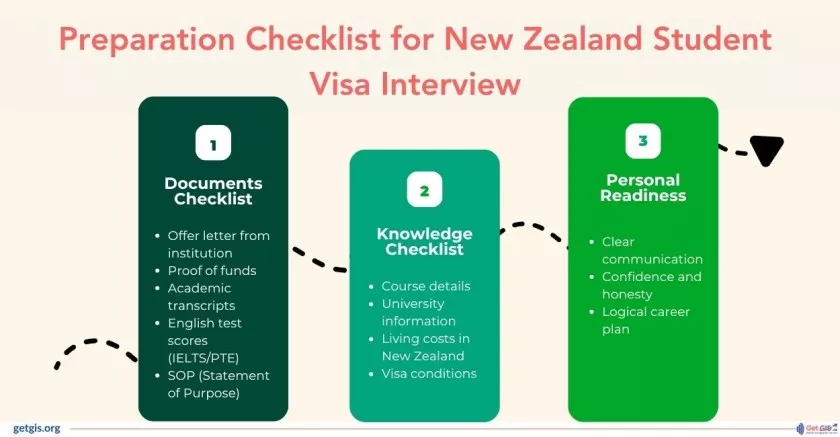
We are so far well-versed with the top New Zealand student visa interview questions for 2026, and exclusive tips to ensure your best preparation and successful interview. Let us further explore the list of documents that you would need to carry for your NZ student visa interview:
- Valid Passport
- Visa application confirmation and fee payment receipt
- Offer of Place (OOP) from a New Zealand educational institution
- Tuition fee payment receipt
- Academic transcripts
- Language Proficiency test scores
- Updaded Resume
- Proof of Funds
- Scholarship or Sponsorship documents (if applicable)
- Medical clearance certificate
- Police clearance certificate
- Statement of Purpose (SOP)
- Passport Size Photographs (as per specification)
To conclude, preparing for a New Zealand student visa interview is not just about answering interview questions; it’s about demonstrating clarity, credibility, and genuine intent. With proper preparation using interview questions for New Zealand Student Visa, structured answers, and awareness of immigration expectations, you can significantly improve your chances of success.
Articles You Might Be Interested in
- Why Study in New Zealand in 2025?
- The Education System in New Zealand
- Top Universities in New Zealand: Fees, Rankings & Job opportunities
- Cost of Studying in New Zealand for Indian Students
- SOP for a New Zealand Student Visa
- New Zealand Visitor Visa Requirements
- MBBS in New Zealand: Scope, Eligibility, Top Colleges, Fees
- Minimum PTE Score for New Zealand in
- Highest Paying Courses in the World
- Best Country for Indian Students to Study Law
- Best Country for Indian Students to Study MS in Economics
- Best Country for Indian Students to Study MS in Psychology
Planning to study in Canada? Explore provinces that improve your PR chances
Frequently Asked Questions
How long is the New Zealand student visa interview?
Is there an interview for an NZ student visa?
Is a New Zealand student visa hard to obtain?
How do you introduce yourself in an interview in NZ?
Does New Zealand reject student visas?
What answers increase visa approval chances for New Zealand?