
Top 10 Countries with Indian Population in 2026: Where Do Indians Mostly Prefer to Live?
Updated On
-
Copy link
The top 10 countries with Indian population in 2026 include the USA, UAE, Malaysia, and Canada. It reflects migration patterns shaped by employment demand, education pathways, business & generations of settled Indian communities across global regions.
Your Complete Canada PR Roadmap- From Eligibility to Visa

Table of Contents
India has one of the largest diasporas in the world, with millions of Indians living, working, and studying across continents. From high-skilled professionals in the United States to blue-collar workers in the Gulf, the Indian population abroad contributes significantly to global economies and India’s remittance inflows.
In many of these countries, Indian communities are deeply rooted, with cultural groups, temples, restaurants, and strong support networks. Let’s explore the top 10 countries with Indian population in 2026, where they are most concentrated.
List of Top 10 Countries with Indian Population
India has the world’s largest overseas diaspora, with approximately 35.4 million Indians living abroad. When looking at the list of the top 10 countries with the largest Indian diaspora populations, you will come across two key terms used to classify Indians living abroad: Non-Resident Indians (NRIs) and Persons of Indian Origin (PIOs).
While an NRI (Non-Resident Indian) refers to an Indian citizen who resides outside India for work, education, or other purposes, PIOs (Person of Indian Origin) are individuals who are not Indian citizens, but whose parents, grandparents, or even earlier generations migrated from India and settled permanently in other countries.
This distinction is crucial when analyzing diaspora data because some countries have a higher number of NRIs (such as Gulf nations), while others have large, well-established PIO populations (such as the US and UK).
The table below allows you to explore these categories separately or combined, offering a clearer picture of how the Indian diaspora has grown globally between 2020 and 2026.
|
Rank |
Country |
NRI Population |
PIO Population |
Total Indian Diaspora |
|---|---|---|---|---|
|
1 |
United States |
2,077,158 |
3,331,904 |
5,409,062 |
|
2 |
United Arab Emirates |
3,554,274 |
14,574 |
3,568,848 |
|
3 |
Malaysia |
163,127 |
2,751,000 |
2,914,127 |
|
4 |
Canada |
1,016,274 |
1,859,680 |
2,875,954 |
|
5 |
Saudi Arabia |
2,460,603 |
2,906 |
2,463,509 |
|
6 |
Myanmar |
2,660 |
2,000,000 |
2,002,660 |
|
7 |
United Kingdom |
369,000 |
1,495,318 |
1,864,318 |
|
8 |
South Africa |
60,000 |
1,640,000 |
1,700,000 |
|
9 |
Kuwait |
993,284 |
2,244 |
995,528 |
|
10 |
Australia |
350,000 |
626,000 |
976,000 |
Source: Ministry of External Affair
Also Read: 10 Essential Documents Required to Travel Abroad from India
Details on Top 10 Countries with Indian Population in 2026
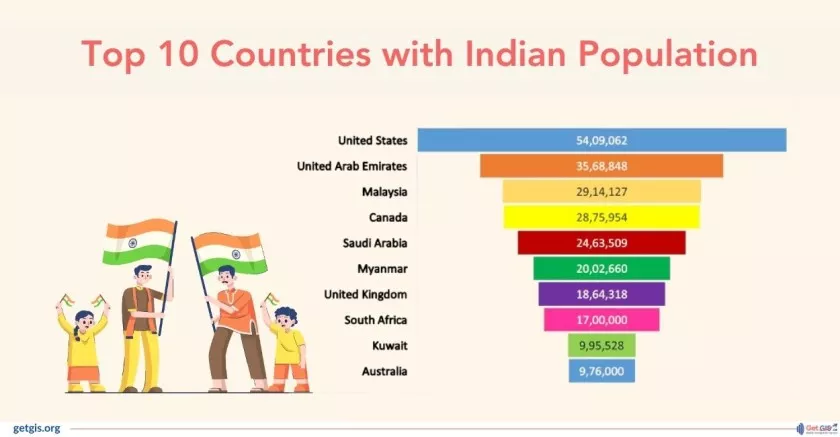 Now that we have listed the top 10 countries with Indian population around the world as on January 2025, let us learn the impact on these countries and the challenges that they face.
1. United States of America
The United States hosts one of the largest and most influential Indian diasporas in the world, with over 5.4 million people of Indian origin. Indian Americans are among the most highly educated and economically successful immigrant groups, contributing significantly to sectors like technology, healthcare, and finance.
Indian communities are concentrated in cities such as Silicon Valley, New York, Chicago, and Houston, where vibrant cultural ecosystems thrive with festivals like Diwali and Holi celebrated at a large scale.
Quick Highlights about Indians in the United States
- The US has seen several leaders of Indian descent, including Vice President Kamala Harris, CEOs like Sundar Pichai (Google), and Satya Nadella (Microsoft).
- Institutions like New York University, Northeastern University, and the University of Southern California are popular choices for Indian students in the US.
- Key sectors with high employment opportunities in the US for Indians include technology, healthcare, finance, and academia.
|
Why Indians Move? |
Challenges |
|---|---|
|
|
Quick Read: Cost of Living in the USA for Students & Professionals
2. The United Arab Emirates
The United Arab Emirates (UAE) has witnessed an exponential increase in its Indian expatriate population over the years. Today, Indians constitute a significant part of the country's total population, with their numbers reaching into the millions. This rapid growth is a testament to the economic opportunities and global exposure the UAE offers to Indian professionals and workers.
Indian communities are prominent in Dubai and Abu Dhabi, where Indian culture is deeply integrated into daily life. Other than that, their cultural contributions can be seen in the presence of Indian restaurants, festivals, and vibrant communities across the Emirates.
Quick Highlights about Indians in UAE
- The Indian community in the UAE significantly contributes to the country's economy, particularly in sectors like construction, retail, and healthcare.
- Indian nationals are responsible for more than 20% of foreign property bought in the country. (Source: Modern Diplomacy)
- Indians account for over 40% of the international student community in Dubai. Stringent visa regulations in Western nations, the UAE's closeness to India, and the presence of numerous international university branches in the UAE have all contributed to this. (Source: Modern Diplomacy)
|
Why Indians Move? |
Challenges |
|---|---|
|
|
Explore: Average Cost of Living in Dubai for Indian Students & Families
3. Malaysia
Malaysia is home to a diverse range of Indian ethnic groups, each contributing to the nation's rich tapestry of cultures. Malaysians of Indian origin primarily consist of Tamils, Malayalees, Punjabis, and Bengalis, among others. This vibrant mix of ethnicities brings a myriad of traditions, languages, and culinary delights to Malaysia.
The Indian community in Malaysia plays an integral role in the nation's development. From trade and commerce to education and politics, Malaysians of Indian descent have been active contributors to the country's progress. Their cultural influence is evident in religious celebrations, festivals like Thaipusam, and the enchanting art of Bharatanatyam, which is widely appreciated.
Quick Highlights about Indians in Malaysia
- Malaysia is recognized as a top MICE (Meetings, Incentives, Conferences, and Exhibitions) destination for Indian corporate groups.
- Malaysia’s affordable education attracts Indian students to institutions like the University of Malaya and University Putra Malaysia.
- Key sectors with high employment opportunities in Malaysia for Indians include manufacturing, plantation industries, and services. IT professionals, engineers, and doctors are among the skilled expatriates frequently relocating to Malaysia.
- Over 65 distinct community associations are listed with the High Commission of India. (Source: High Commission of India, Kuala Lumpur Malaysia, Ministry of External Affairs, Government of India)
|
Why Indians Move? |
Challenges |
|---|---|
|
|
4. Canada
The country has been a destination of choice for Indian immigrants seeking a better quality of life and new opportunities. With a significant presence of Indian Canadians across the country, the Indian diaspora has shaped the multicultural fabric of Canada, contributing to its reputation as one of the world's most diverse nations.
The diversity of Indian communities in Canada is evident in the array of cultural festivals, religious celebrations, and culinary traditions that enrich the country's multicultural landscape.
Quick Highlights about Indians in Canada
- Indo-Canadians have excelled in politics, business, and the arts with figures like Harjit Sajjan and poet Rupi Kaur.
- The Toronto census metropolitan area, with 55.3% of Canada's Hindu population, experiences the most brilliant Diwali lights. (Source: Statistics Canada)
- Canada is one of the most favoured destinations for Indian students, with universities like the University of Toronto, the University of British Columbia, and McGill University being popular choices.
- Key sectors with high employment opportunities in Canada for Indians include Information technology, engineering, healthcare, and finance.
|
Why Indians Move? |
Challenges |
|---|---|
|
|
Check Out: Cost of Living in Canada
5. Saudi Arabia
Indians constitute about 10–13% of Saudi Arabia's population, which is the largest expatriate community there. They consist of skilled professionals who have made substantial contributions to the nation's infrastructure and economic development.
Indian cultural centers and community groups have flourished in Saudi Arabia, providing a platform for Indian expatriates to celebrate their cultural heritage. Events like Diwali, Holi, and Eid are celebrated with enthusiasm and offer a taste of home to the Indian community residing in the Kingdom.
Quick Highlights about Indians in Saudi Arabia
- Saudi Arabia is not a crucial destination for Indians. However, students are willing to gain knowledge or pursue studies in Islamic studies and Arabic language programs.
- Certain Indian states dominate the migration pattern in Saudi Arabia, namely, Kerala (approx. 40%), Telangana (approx. 20-25%) and others like Maharashtra, Uttar Pradesh and Rajasthan.
- Indian expatriates reside in key Saudi urban and industrial areas, such as Riyadh (approximately 1 million), Jeddah (approximately 70,000), Dammam, Jubail and Jizan.
- Key sectors with high employment opportunities in Saudi Arabia for Indians include construction, healthcare, and information technology.
Source: Ministry of External Affairs (MEA), Government of India Population estimates and migration studies
|
Why Indians Move? |
Challenges |
|---|---|
|
|
6. Myanmar
Myanmar, formerly known as Burma, has a rich history intertwined with the presence of Indian settlers dating back to ancient times. Indians played an instrumental role in establishing important trade routes and bolstering the socio-economic framework of the region.
The Indian community in Myanmar has had a profound impact on the socio-cultural fabric of the nation. Over the centuries, they have made significant contributions to various sectors.
Quick Highlights about Indians in Myanmar
- The Indian community in Myanmar has made historic contributions in sectors like trade, commerce, and the cultural landscape.
- Myanmar is one of the prominent destinations for educational exchange.
- Cities like Yangon (Rangoon), Mandalay, Pyin U Lwin and Kalaw have the maximum number of Indian population.
- The religious practices of Burmese Indians include Hinduism, Islam, Sikhism, Buddhism, and Christianity.
- Burmese Indians are mostly from states like Tamil Nadu, Andhra Pradesh, Rajasthan, and West Bengal.
Source: Ministry of External Affairs (MEA), Government of India Population estimates and migration studies
|
Why Indians Move? |
Challenges |
|---|---|
|
|
7. The United Kingdom
The United Kingdom shares deep historical ties with India, dating back to colonial times. Today, the Indian diaspora in the UK is a vibrant and integral part of British society. The presence of numerous Indian communities, especially in cities like London, has led to a cross-pollination of cultures and traditions.
Indian immigrants have made significant contributions to the UK's multicultural society. From politics and business to the arts and academia, individuals of Indian origin have excelled in various fields. The UK is home to a wide range of Indian restaurants like Michelin-starred “Opheem” in Birmingham and “Chokhi Dhani” in London, cultural events and festivals like Holi and Diwali, and religious sites, highlighting the enduring connection between the two nations.
Quick Highlights about Indians in the UK
- Indians constitute 3.1% of the total population in the United Kingdom. They predominantly settle in England and Wales.
- The UK has seen several leaders of Indian descent, including Rishi Sunak (British Prime Minister in October 2022), Priti Patel (former Home Secretary), Alok Sharma (former President of COP26), in Business figures like Sir Anwar Pervez (Bestway Group) Lakshmi Mittal (CEO ArcelorMittal), etc.
- In December 2025, Indian nationals were granted 95,231 sponsored study visas, surpassing Chinese students to become the largest group of international students in the UK. (Source: Education Today)
- Popular university choices among Indians include the University of Oxford, the University of Cambridge, Imperial College London, and the London School of Economics (LSE).
- Key sectors with high employment opportunities in the UK include technology, healthcare, finance, academia and research.
|
Why Indians Move? |
Challenges |
|---|---|
|
|
Also Read: Cost of Living in the UK for Indian Students & Families
8. South Africa
The history of the Indian diaspora in South Africa is deeply rooted in the country's past. Indian laborers were brought to South Africa during the colonial era, and their contributions left a lasting legacy. Today, South Africa is home to a substantial Indian community that has integrated with the broader South African society.
The Indian community in South Africa has significantly impacted the nation's cultural and political landscape. Prominent leaders like Mahatma Gandhi emerged from this community and played vital roles in the fight for South Africa's independence. The Indian influence is apparent in the flavors of Durban's spicy cuisine, religious diversity, and cultural celebrations like Diwali.
Quick Highlights about Indians in South Africa
- Indians constitute 2.5% of the total population in South Africa
- Though not a prime study destination, a few of popular university choices are the University of Cape Town, the University of the Witwatersrand, and Stellenbosch University.
- Key sectors with high employment opportunities in South Africa include trade, retail, manufacturing, and professional services like medicine and law.
|
Why Indians Move? |
Challenges |
|---|---|
|
|
9. Kuwait
Kuwait hosts one of the most significant Indian expatriate populations in the Gulf, with over 1.05 million Indians as of 2026, making them the largest expatriate group, accounting for nearly 20% of the country’s total population. They make up approx. 30% of the private sector workforce and approximately 33.9% of the total expatriate workforce. Additionally, Kuwait is a major source of remittances to India, highlighting the financial contribution of Indian workers abroad.
Despite being abroad, Indians in Kuwait actively celebrate festivals such as Diwali, Onam, Eid (among Indian Muslims) and Holi. Over the decades, they have become deeply embedded in Kuwait’s workforce and economic ecosystem.
Quick Highlights about Indians in Kuwait
- Indians are concentrated in key urban and industrial areas such as Kuwait City, Farwaniya, Jleeb Al-Shuyoukh and Al Jahra. These regions serve as hubs for both professionals and blue-collar workers, creating strong community networks.
- Indian migrants in Kuwait are primarily NRIs, with a large proportion coming from states like Kerala, Tamil Nadu, and Andhra Pradesh.
- A notable cultural event is Bharat Mela 2026, which showcases Indian music, dance, and cuisine with participation from 700+ artists, reflecting the vibrant cultural integration of Indians in Kuwait.
- Indians play a critical role in Kuwait’s economy, especially in healthcare (doctors, nurses), engineering and construction, retail and small businesses, and domestic and service sectors.
|
Why Indians Move? |
Challenges |
|---|---|
|
|
Source: IndiansinKuwait
10. Australia
Australia has emerged as one of the fastest-growing destinations for Indians, with the total diaspora nearing 1 million in 2026. Indians are now the second-largest migrant group in the country and among the most rapidly expanding communities.
According to official data, over 916,000 Indian-born residents were already living in Australia by 2024, accounting for 3.4% of the total population, with strong growth continuing through 2026.
Indian culture is highly visible in Australia through festivals and events like Diwali celebrations in Melbourne and Sydney, Holi festivals across universities and communities and National Indian Film Festival of Australia (NIFFA), one of the largest showcases of Indian cinema globally (Source: The Times of India). These celebrations not only preserve Indian heritage but also contribute to Australia’s multicultural identity.
Quick Highlights about Indians in Australia
- Indian communities are highly concentrated in metropolitan cities such as Melbourne (largest Indian population), Sydney, Brisbane, Perth and Adelaide.
- Indian migrants have a strong impact on Australia’s economy and society, particularly in IT and software services, healthcare and aged care, education and research and small businesses and entrepreneurship.
- Indians are among the most highly educated migrant groups, with over 64% holding a bachelor’s degree or higher.
- They form the high workforce participation rate of approximately 79%, boosting economic productivity.
- They significantly contribute to the international student economy, with over 120,000+ Indian students.
- Indian Australians are also increasingly influencing politics, sports (especially cricket), and cultural life, reflecting deeper integration into mainstream society.
Sources: Indians in Australia: How the Community Reached 1 Million; Cultural Atlas
|
Why Indians Move? |
Challenges |
|---|---|
|
|
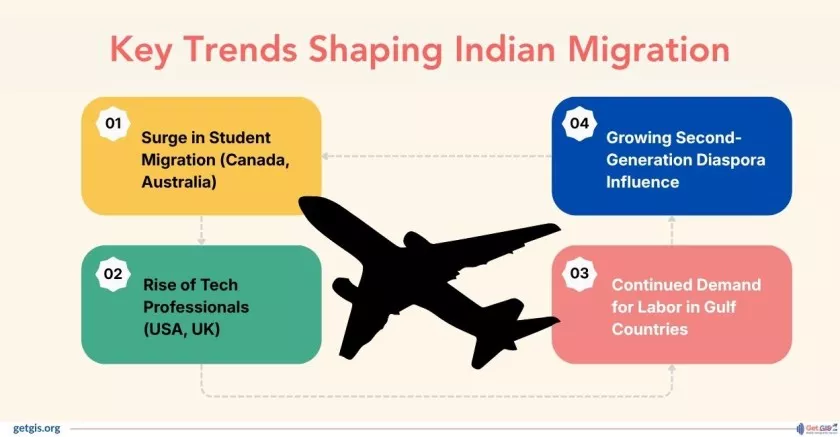
Key Trends Shaping Indian Migration (2020–2026)
Indian migration patterns have undergone a significant transformation between 2020 and 2026, driven by global economic shifts, evolving immigration policies, and changing aspirations among Indian youth. Below is a detailed breakdown of the major trends shaping the Indian diaspora worldwide.
Surge in Student Migration (Canada, Australia)
Student migration remains one of the strongest drivers of Indian mobility, even with slight fluctuations due to policy changes.
- In 2025, over 1.2 million Indian students were studying abroad globally, making India the largest source of international students.
- Canada alone hosted approximately 427,000 Indian students, followed by:
- USA: 331,600 students
- UK: 185,000 students
- Australia: 122,000 students
- However, stricter visa policies led to a 5.7% decline in total students in 2025 compared to 2024.
This data signifies that Indian students are increasingly using education as a migration pathway to permanent residency (PR). From our recent interactions with applicants, we have also noticed that there is a shift toward alternative destinations like Germany and Ireland, reflecting diversification.
Rise of Tech Professionals (USA, UK)
Highly skilled Indian professionals continue to dominate global talent pipelines, particularly in technology and innovation.
- The US remains the top destination with over 331,000 Indian students, many transitioning into the workforce via OPT and H-1B visas.
- The UK has seen strong demand, with approximately 185,000 Indian students and rising skilled worker visa approvals (approx. 91%).
- Indian professionals are heavily concentrated in AI, software engineering, fintech, and healthcare sectors.
- Migration is increasingly skill-based rather than labor-based in developed economies.
Continued Demand for Labor in Gulf Countries
The Gulf region continues to rely heavily on Indian labor, especially in infrastructure and service industries.
- India received a record $135.46 billion in remittances in FY 2024–25, largely from Gulf countries, North America, and Europe. (Source: The Economic Times)
- Gulf countries maintain 90–95% work visa approval rates for Indians, reflecting strong labor demand.
It means that Gulf migration remains economically critical, especially for semi-skilled and blue-collar workers. Moreover, remittances continue to be a major pillar of India’s economy.
Growing Second-Generation Diaspora Influence
The Indian diaspora is now transitioning into its second and third generations, especially in developed countries.
- The global Indian diaspora reached 35.4 million people (MEA 2024–25), the largest in the world.
- Second-generation Indians are increasingly represented in:
- Politics (e.g., global leadership roles)
- Corporate leadership
- Media and academia
It signifies that migration is shifting from temporary movement to permanent global integration and second-generation Indians are shaping global narratives, policies, and economies.
To conclude, the global Indian diaspora in 2026 reflects a dynamic blend of opportunity, legacy, and long-term settlement across diverse regions. From education-driven migration in countries like Canada and Australia to employment-focused movement in the Gulf, Indians continue to shape and strengthen economies worldwide. As migration patterns evolve, the Indian community abroad is not just growing in numbers but also in influence, contributing significantly to global innovation, culture, and leadership.
Articles You Might Be Interested In
Visiting Canada now? Understand how it connects to future PR pathways
Frequently Asked Questions
Which country has the least Indian population?
Where do Indians migrate to the most?
Which city has the highest Indian population in the world?
How many Indians live outside India?
Which are the best countries for Indians to settle?
- Germany
- Australia
- New Zealand
- Singapore
- Ireland
- The United Kingdom
- United Arab Emirates
- The Netherlands
- Sweden
How many Indians live in South Korea?
Which countries are easiest for Indians to migrate to?